Pourquoi 90% des plannings ne tiennent pas contractuellement

Why 90% of project schedules fail to meet contractual requirements Introduction: In the major projects industry — particularly in the EPC sector — scheduling is ubiquitous. It structures project delivery, aligns teams and drives performance. And yet. When a project goes off track, deadlines are missed and responsibilities need to be established… the vast majority of schedules become […]
Why 80% of delays are not lost due to execution

Why 80% delays are not due to poor execution Introduction: The myth of the “failing construction site” In the collective imagination of the construction industry, a project running behind schedule is often seen as synonymous with a poorly executed site: lack of productivity, poor organisation, inefficient teams. Yet the reality of complex projects (EPC, nuclear, infrastructure) is quite […]
Critical Path Delays: Why Major Projects Always Run Late — A Structural Law of Complex Systems

Why large-scale projects always run late — and why it’s not a failure, but a structural law Introduction: Understanding the delays affecting the critical path in megaprojects After decades of observing megaprojects in engineering, infrastructure, energy, and IT, an uncomfortable truth consistently emerges: Large-scale projects don’t take […]
Microsoft Project: Strengths, Limitations and Best Practices for Complex Project Environments

Microsoft Project: Strengths, Limitations, and Best Practices for Complex Project Environments Introduction: In the realm of project controls and scheduling, Microsoft Project (MSP) has long been a go-to tool. From infrastructure and energy to IT and construction, it remains one of the most widely used scheduling software packages […]
Contractual time obligations: why the schedule is a legal document

Contractual time obligations: why the schedule is a legal document 1. Introduction In the world of energy and infrastructure megaprojects, time is not just a project management variable – it is a contractual obligation. Delays can lead to liquidated damages (LDs), disputes, and even the [...]
PMO and Project Portfolio Management (PPM): understanding the real difference

PMO and Project Portfolio Management (PPM): understanding the real difference Introduction: In today's complex project environments – whether in infrastructure, energy, technology, or engineering – organisations often use the terms PMO and Project Portfolio Management (PPM) interchangeably. Yet, while both these functions play an essential role in [...]
Deploying next-generation data centres: reliability, efficiency, and sustainability at the heart of digital capabilities

Deploying next-generation data centres: reliability, efficiency and sustainability at the heart of digital capabilities. Market context: demand growth, technological density and time pressure. The global data centre market is experiencing rapid growth, driven by the rise of artificial intelligence, cloud computing and edge computing. […]
The Strategic PMO: Moving from a Support Function to a Value Creation Lever

The Strategic PMO: Moving from a Support Function to a Value Creation Lever Introduction: In today's complex environment, organisations are simultaneously undertaking multiple projects, programmes and portfolios, often within a context of shifting priorities, stringent constraints and high stakeholder expectations. In this context, a well-structured PMO and […]
Optimising marine works and offshore operations: the importance of strategic planning and scheduling

Optimisation des travaux maritimes et des opérations offshore : l’importance d’une planification et d’un ordonnancement stratégiques Introduction : Les industries maritimes et offshore sont complexes, exigeantes et opèrent souvent sous des contraintes de calendrier strictes ainsi que dans des conditions environnementales difficiles. Le succès des opérations repose sur une planification et un ordonnancement précis, afin de […]
Mastering deadline analysis and responsibility allocation in consortium projects: best practices from the field
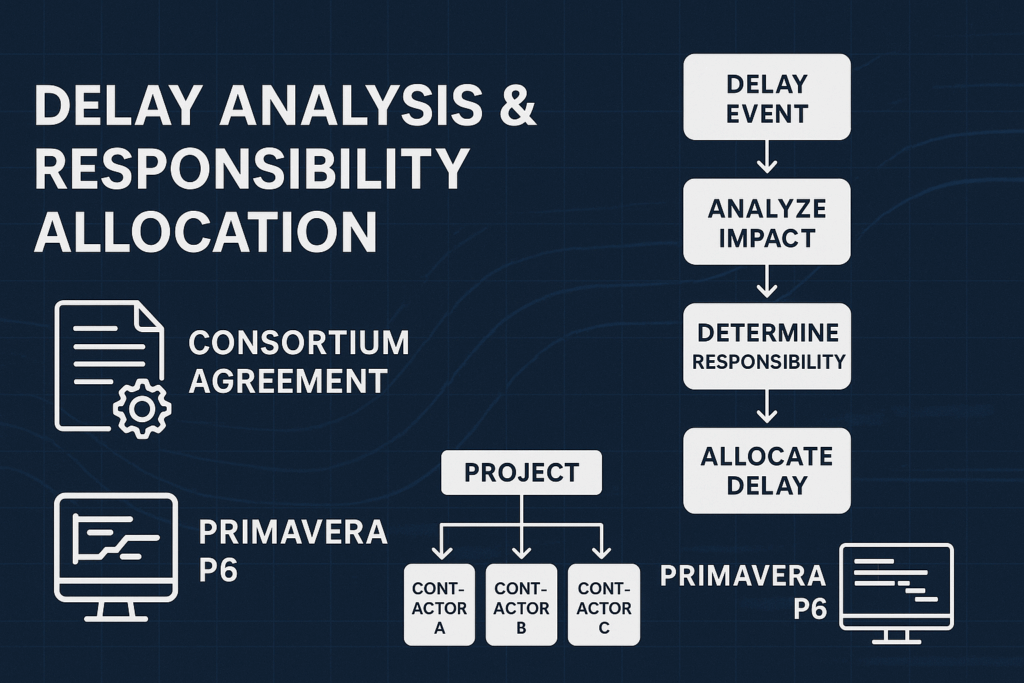
Mastering Schedule Analysis and Responsibility Allocation in Consortium Projects: Best Practices from the Field Introduction: In today's increasingly complex infrastructure and energy sectors, projects are now carried out in the form of consortia – where multiple contractors join forces to pool specialised expertise, share the […]
 Français
  English (UK)
  Español
  Italiano
  Deutsch
  Nederlands