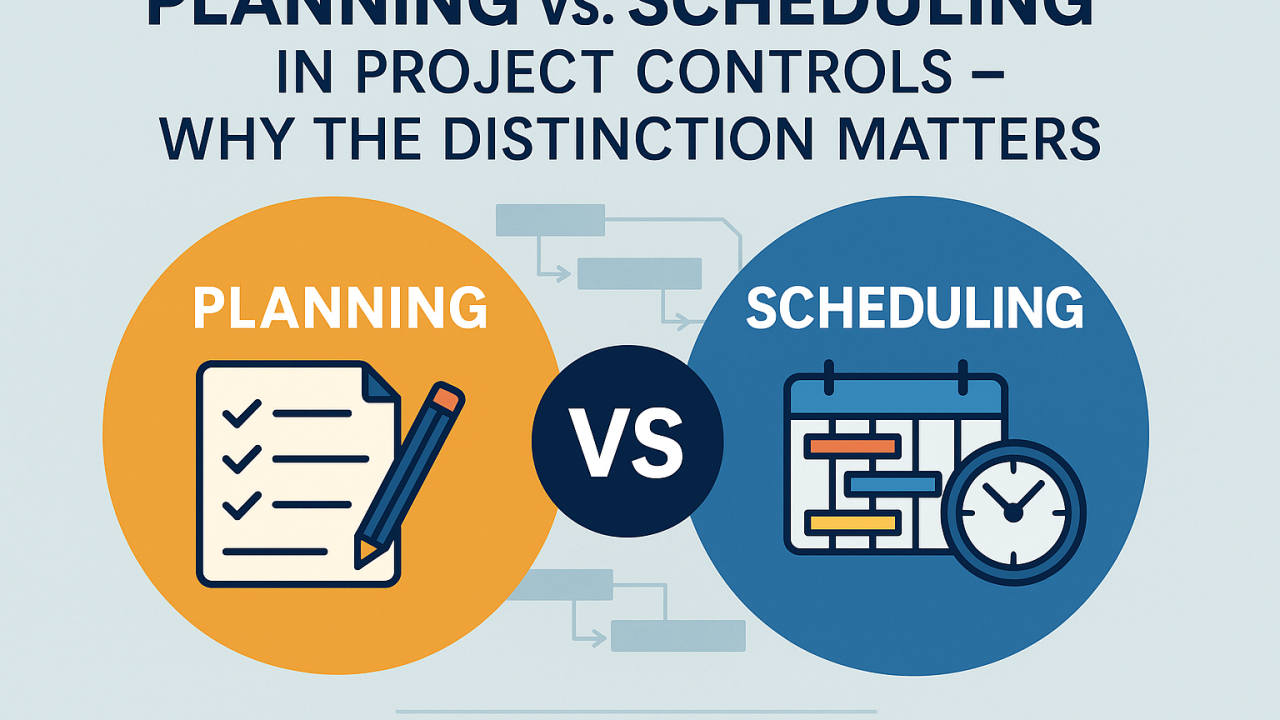
Planning vs. Scheduling in Project Controls: why the distinction is essential
Introduction :
In the field of Control Measures, particularly in the construction, infrastructure, and oil & gas sectors, two terms are often used interchangeably: planning and ordonnancement.
Although closely linked, they respond to different objectives and require distinct skills. At ALVID Consulting, we assist our clients daily in bridging this gap, using tools such as Oracle Primavera P6 to transform global strategies into detailed and manageable execution plans.
Let's see the difference concretely:
What is planning?
The Planning corresponds to the strategic phase of project controls. It answers the following questions:
- What is to be done?
- How are we going to do it?
- Who is responsible?
- What are the constraints and assumptions?
Key components of planning:
- Definition of scope from the project documents (SOW, BOQ)
- Development of the WBS project structuring into manageable work packages
- Identification of activities : full list of tasks to be completed
- Duration estimation Based on experience and productivity
- Resource planning labour, equipment, materials
- Calendar Assignment Working days, teams, exceptions
- Risk identification Potential impacts on scope and timelines
In Primavera P6: The planner constructs the schedule structure via the WBS, Activity Codes, calendars, and resources — without yet setting precise dates.
What is scheduling?
The’Scheduling consists of applying temporal logic and constraints to the plan. It answers the questions:
- When does each task start and end?
- What is the sequence of works?
- What is the overall project duration?
- Where is the critical path located?
Key scheduling components:
- Logical relations FS (Finish-to-Start), SS (Start-to-Start), etc.
- Constraints type “Start No Earlier Than”, “Mandatory Finish”…
- Schedule calculation (F9 in P6) earliest/latest dates, float, critical path
- Baseline creation : reference for analysing discrepancies
- Progress update actual vs forecast
- Performance analysis Earned Value, S-curves, etc.
In Primavera P6: The scheduler defines relationships, launches the CPM engine, and generates dates, float, and critical activities.
Brief comparison
- Planning = Strategic vision (what, how, with what resources)
- Scheduling operational translation over time (when, in what order, with what impact)
Why is this distinction essential
Many delays do not stem from execution, but from:
- of one Poorly structured planning,
- or of a poorly constructed schedule (flawed logic).
Project excellence relies on a combination of the two:
- clear planning,
- a rigorous and realistic schedule.
At ALVID Consulting, we align strategy and execution by developing Integrated Master Schedules (IMS) Robust under Primavera P6.
Conclusion
To plan without scheduling is a wish.
To command without planning is an approximation.
Success lies in the combination of both, with method, discipline and appropriate tools.
If you wish to structure or improve your schedule, or develop a Solid and defensible IMS, ALVID Consulting is ready to support you – from design to execution.
 Français
  English (UK)
  Español
  Italiano
  Deutsch
  Nederlands