5 common errors that lead to claims in construction
Introduction :
In complex construction projects, claims are not simply a risk – they are often inevitable. Whether they arise from scope creep, delays, or communication issues, claims can disrupt project delivery, increase costs, and damage stakeholder relationships.
This article presents five major pitfalls that frequently lead to claims in construction contracts, along with practical recommendations for avoiding them. The lessons below are based on principles taught in leading Construction Law & Dispute Resolution programmes, notably at King's College London, and are aligned with international contractual standards such as FIDIC and NEC.
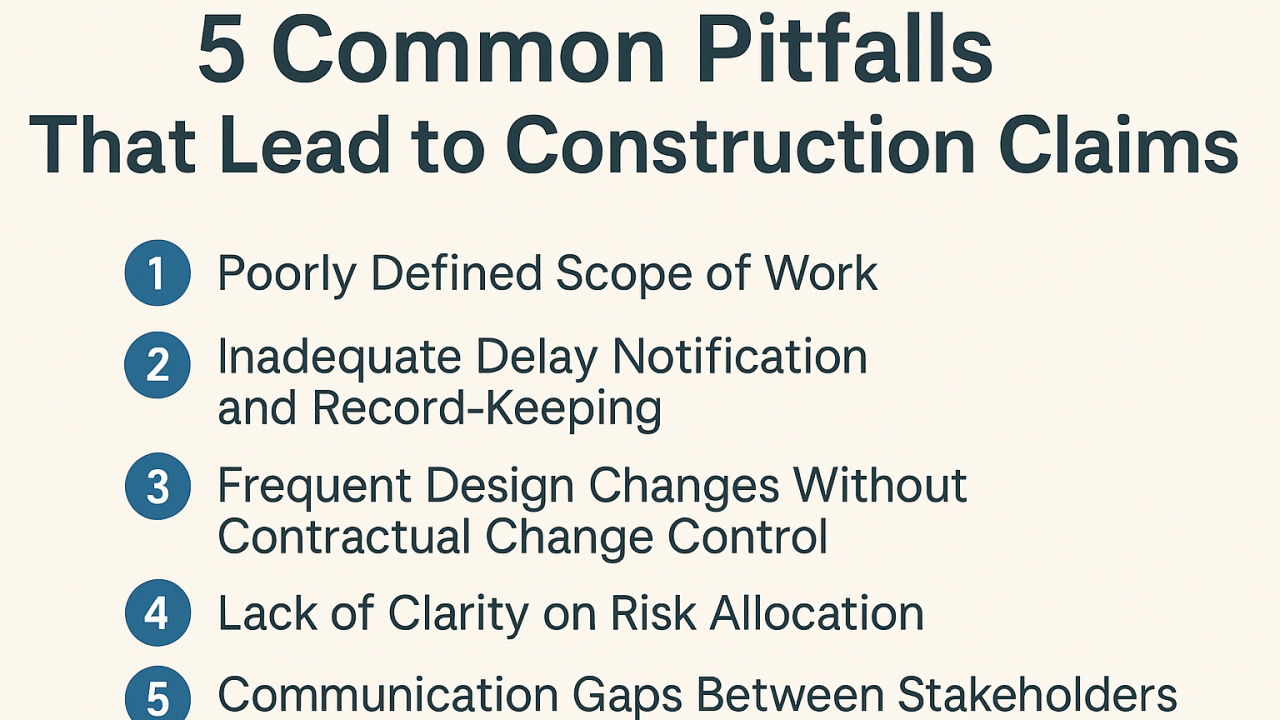
The scope of work is poorly defined
Why this is a problem:
An ambiguous or incomplete scope can lead to differing interpretations of contractual obligations, with the contractor viewing certain tasks as included, while the client considers them additional services, generating variation claims.
Real-life example:
A contractor starts foundation work, assuming site clearance is included. The client considers it a separate service. Result: delay and a claim for additional payment.
How to avoid:
- To define the scope with precision and technicality
- Use a WBS and a detailed BOQ to avoid overlaps
- Explicitly include exclusions in the tender documents
2. Late notification of delays and poor record-keeping
Why this is a problem:
Most standard contracts (e.g. FIDIC Clause 20) require prompt notification of delay events. Failure to comply with notification deadlines often results in the rejection of claims, even if they are well-founded.
Real-life example:
Significant rain prevents site access for 2 weeks, but the contractor notifies the engineer 21 days later – beyond the contractual 14-day limit. The entitlement to an extension of time is lost.
How to avoid:
- Set up a real-time site diary
- To train teams to immediately identify reportable events.
- Automate contractual alerts using planning tools
3. Frequent design modifications without contractual control
Why this is a problem:
Informal changes lead to scope creep. Without formal management via Variation Orders, disputes arise over costs and time impacts.
Real-life example:
An architect provides sketches to modify a facade without formal instruction. The contractor carries out the work, claims costs, and the client disputes the validity.
How to avoid:
- Strictly adhere to change management procedures (e.g. FIDIC Clause 13)
- All instructions must be issued in writing and approved by the Engineer / PM.
- Maintain a change log with cost/time analysis
4. Lack of clarity in risk allocation
Why this is a problem:
Disputes arise when contracts do not clearly allocate risks (ground conditions, material inflation, etc.).
Real-life example:
The contractor is encountering rock during earthworks, but the contract does not specify geotechnical risk management. The client is refusing any compensation.
How to avoid:
- Use risk matrices from the pre-contractual phase
- To rely on reference geotechnical reports
- Allocate the risks to the party best able to control or insure them
5. Communication failures between stakeholders
Why this is a problem:
A lack of alignment between stakeholders (contractor, client, consultants) can quickly turn misunderstandings into claims, particularly in international or consortium projects.
Real-life example:
A joint venture partner applies local standards, while the client demands Eurocodes. Result: non-compliance and costly rework.
How to avoid:
- Organise regular multidisciplinary coordination meetings
- Define a clear and shared Project Execution Plan
- Establish a single point of contact for instructions and validations
Conclusion
Claims in construction are often a symptom of deeper failures in project management or contractual administration.
By adopting a proactive approach — clear scope, rigorous change management, traceability, and communication — stakeholders can significantly reduce risks and maintain project performance.
For professionals and future experts in construction law and dispute resolution, mastering these fundamentals is essential. The ability to anticipate and manage claims is now a key skill for all stakeholders in a project's lifecycle.
 Français
  English (UK)
  Español
  Italiano
  Deutsch
  Nederlands