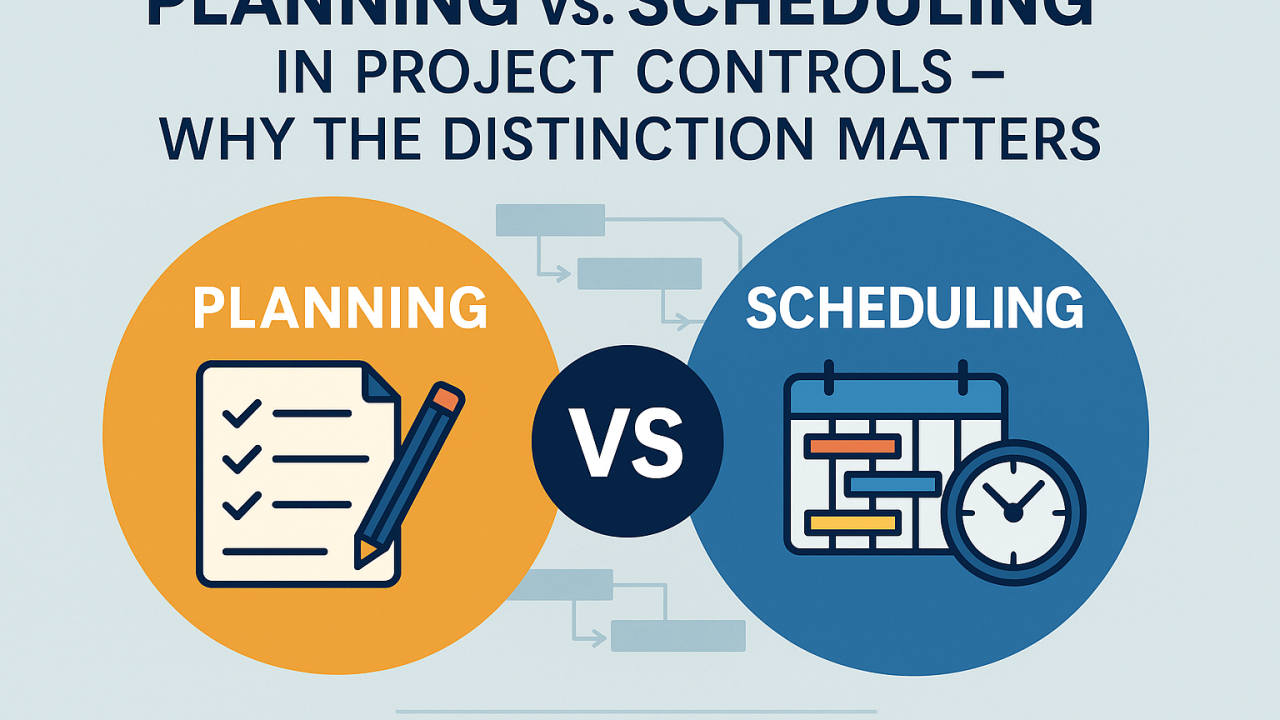
What is Planning?
Planningis the strategic phase of project controls. It answers:
 What needs to be done?
. How will we do it?
Who is responsible?
What are the constraints and assumptions?
Key Components of Planning:
- Defining the project scopeUsing project documentation like SOW and BOQ to identify all deliverables.
- Developing a Work Breakdown Structure (WBS)Structuring the project into manageable sections.
- Identifying activities: Listing all the tasks required to complete the project.
- Estimating durationsBased on experience, productivity rates, and crew availability.
- Resource PlanningDetermining which labor, equipment, and materials are needed.
- Assigning calendarsTo account for working days, shifts, holidays, and exceptions.
- Risk identificationDocumenting risks and considering their impact on scope and time.
In Primavera P6The planner will use the WBS, Activity Codes, Calendars, and Resources to build the structure of the schedule without assigning specific dates yet.
What is Scheduling?
Scheduling is the process of applying time logic and constraints to the project plan. It answers:  When will each task start and finish? What is the sequence of work? What is the project duration and end date? Where is the Critical Path?
Key Components of Scheduling:
- Applying logic relationshipsFinish-to-Start (FS), Start-to-Start (SS), etc., to define sequence.
- Setting constraints: Like “Start No Earlier Than” or “Mandatory Finish.”
- Running schedule calculations (F9 in Primavera P6): To compute early/late dates, total float, and the Critical Path.
- Baseline creationCapturing the approved schedule for future variance analysis.
- Updating actualsRegular progress updates to reflect work completed and forecast remaining durations.
- Schedule performance analysisUsing tools like Earned Value and S-curves.
In Primavera P6The scheduler will assign logic relationships, run the CPM engine, and generate early/late start/finish dates, float, and critical activities.
Side-by-Side Comparison:

Why It Matters
Many project delays occur not due to poor execution, but because the initial planning lacked clarity or the schedule was built without logic. Merging good planning with sound scheduling creates a realistic, actionable, and measurable path to project success.
At Alvid Consulting, we specialize in both - developing complete integrated project schedules using Primavera P6, that align planning strategy with scheduling precision.
Final Thought
 Planning without scheduling is a wish.
Scheduling without planning is a guess.
Success lies in combining both with discipline, structure, and the right tools.
If you're struggling to build or manage your schedule, or want to develop a solid Integrated Master Schedule (IMS), our team is ready to help.
 Connect with us to learn how Alvid Consulting can support your project from concept to completion.
 Français
  English