Poor progress in project execution: contractual implications and the role of Primavera P6
Introduction :
In complex projects – particularly in the engineering, construction, defence, and oil & gas sectors – insufficient progress is one of the principal causes of disputes, cost overruns, and schedule delays. Identifying, managing, and contractually dealing with this poor progress represent a key responsibility for both employers and contractors.
This article examines how poor progress is handled in major contract models, as well as the role of Primavera P6 – the industry's benchmark scheduling software – as an analytical foundation for its identification and management.
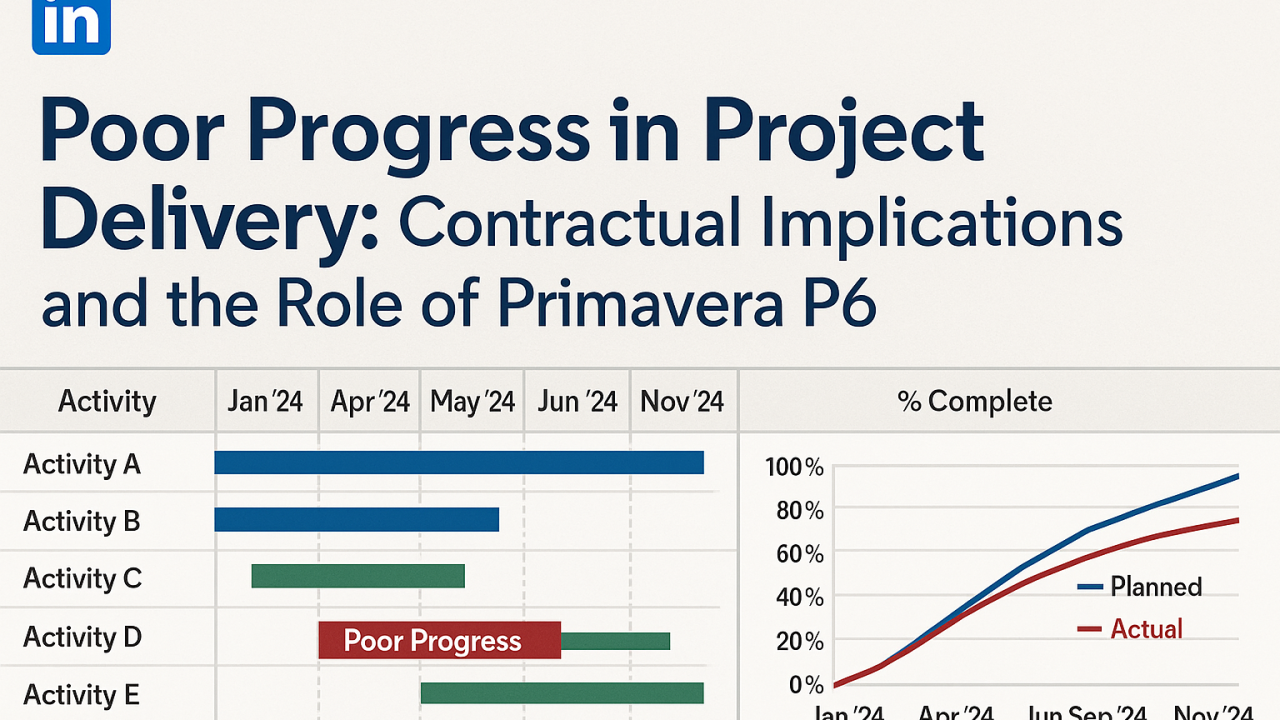
In complex projects – particularly in the engineering, construction, defence, and oil & gas sectors – insufficient progress is one of the principal causes of disputes, cost overruns, and schedule delays. Identifying, managing, and contractually dealing with this poor progress represent a key responsibility for both employers and contractors.
This article examines how poor progress is handled in major contract models, as well as the role of Primavera P6 – the industry's benchmark scheduling software – as an analytical foundation for its identification and management.
Understanding poor progress
Poor progress corresponds to the inability to achieve planned milestones or productivity levels, generally measured against an approved baseline. It reveals inefficiencies or delays that could jeopardise on-time delivery.
Indicators of poor progress
- The activities are starting late or not at all.
- The % progress figure is significantly below the forecast curve
- The remaining time is increasing without justification.
- Total Float becomes negative or decreases on critical/near-critical paths
- Earned Value indicators such as the SPI (Schedule Performance Index) are falling below 1.0
Poor progress in contracts: obligations and remedies
FIDIC Contracts (Red, Yellow, Silver Books)
FIDIC requires the contractor to carry out the Works with «due diligence and without delay». According to Sub-Clauses 8.6 (Programme) and 8.7 (Delay Damages):
- The contractor must regularly update the programme (often in P6)
- A deterioration in progress may lead to a request for a revised programme or a letter before action.
- Persistent poor progress may justify termination.
NEC4 Contracts
NEC4 places emphasis on early warning and proactive communication. According to Clause 31 (Programme) and Clause 16 (Early Warning):
- The contractor must notify any situation liable to cause a delay
- Failure to update the approved programme may result in the loss of entitlement to compensation.
- Repeated poor progress can be considered a breach of contract.
3. AIA and ConsensusDocs (US contracts)
These contracts generally require:
- The submission of a CPM (Critical Path Method) schedule, often using Primavera P6
- Regular updates with variance analysis
- The client can suspend payments, demand a recovery schedule, or apply liquidated damages.
4. EPC and Turnkey Contracts
These high-risk (lump sum) contracts impose strict obligations:
- Maintaining a baseline and adhering to fixed contractual milestones
- In case of non-performance: back charges, retention of funds blocked or activation of parent company guarantees
Primavera P6: Driving and demonstrating progress
Primavera P6 plays a central role in demonstrating progress – or the lack thereof. With its robust scheduling engine and analytical capabilities, it is the go-to tool for supporting claims or demonstrating underperformance.
P6 Tools for detecting poor progress:
- Baseline vs. current dates : identification of start/end drift
- Progress Spotlight : visualisation of expected work over the period
- Types of advancement (%) duration, physical or units according to the contract
- Analysis of float and critical path impact on milestones
- Earned Value SPI/CPI for performance diagnosis
- Delay Analysis (TIA) Impact analysis of delays
Catch-up via P6
In the event of poor progress, the contractor must produce:
- One Recovery Schedule
- “What-if” scenarios (resources, logical re-sequencing)
- Updated forecasts (labour, costs, equipment)
Contractual and operational impacts
Poor progress also affects:
- Customer trust
- Coordination with the supply chain
- The project's overall risk profile
Best practices for mastering poor progression
- Baseline validation to obtain formal client agreement from the outset
- Frequent updates Weekly, bi-weekly or monthly
- Narrative reporting explain the gaps with clear context
- Transparent change management draw and baseline if necessary
- Contractual alignment to reflect obligations in the planning logic
- Forensic traceability archive P6 files, logs and progress histories
Conclusion
«Poor progress» is not just a technical deviation – it is a strong indication of management issues and a major contractual risk.
With the right tools, particularly Primavera P6, and a keen understanding of contractual requirements, project teams can remain compliant, proactive, and capable of defending their position.
To truly master progress, it is essential to establish rigorous discipline in schedule updates, align project control with contractual obligations, and strengthen communication between site and scheduling.
It is at this price that projects can react quickly, recover effectively, and achieve their goals successfully.
 Français
  English (UK)
  Español
  Italiano
  Deutsch
  Nederlands