Mastering deadline analysis and responsibility allocation in consortium projects: best practices from the field
Introduction:
In today's increasingly complex infrastructure and energy sectors, projects are now carried out in the form of consortiums – where multiple contractors join forces to pool specialised expertise, share risks, and achieve large-scale efficiency. However, when delays occur, particularly in high-value, time-sensitive environments, the issue of assigning responsibility becomes a delicate balancing act between legal, technical, and relationship considerations.
At ALVID Consulting, we recently supported a leading consortium project facing issues with delay attribution in a context of complex contractual and technical interdependencies. Without going into specific details, the lessons learned offer valuable insights into best practices for schedule analysis and responsibility allocation — particularly in shared environments like Primavera P6 databases.
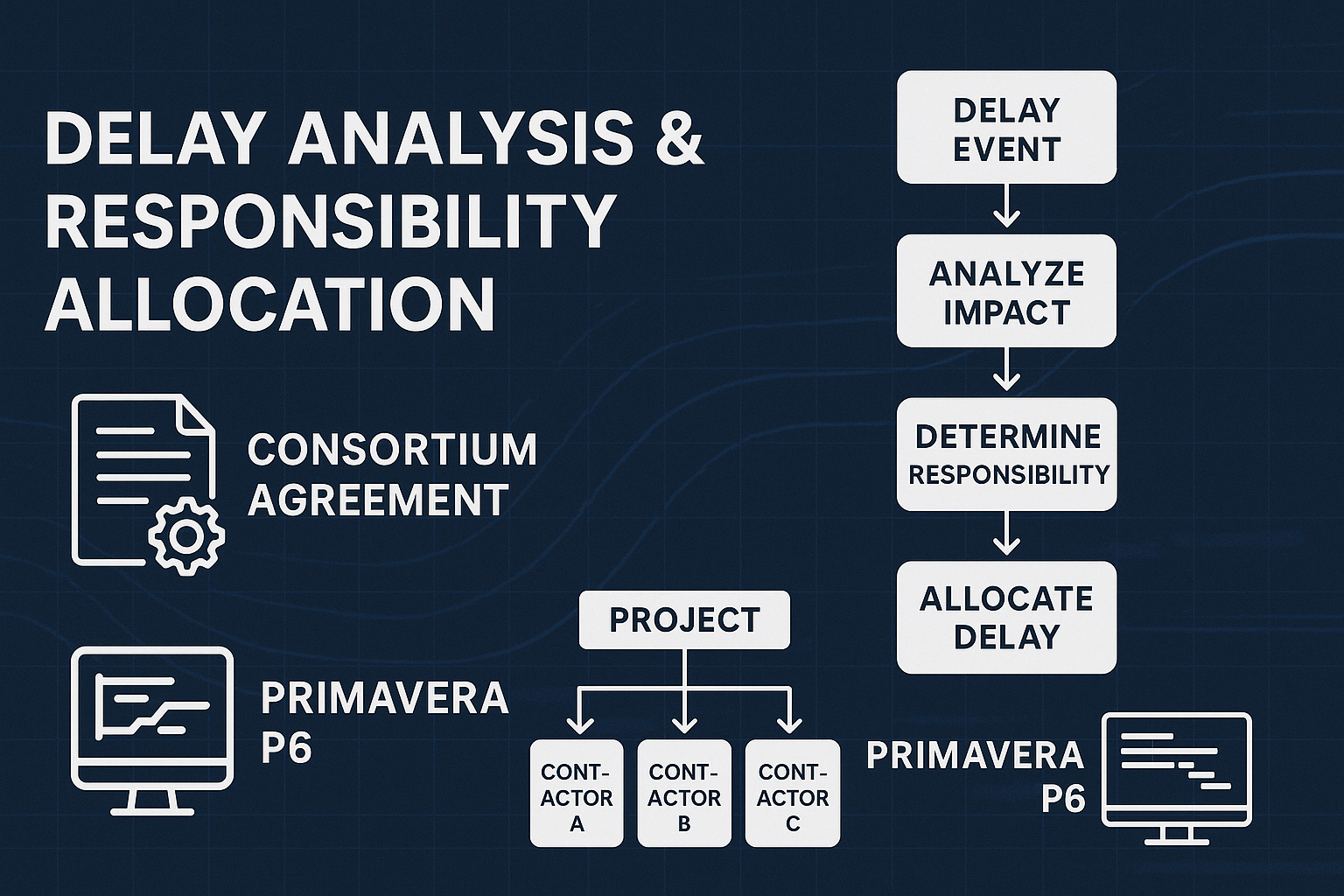
1. Clear responsibility matrix in consortium agreements
One of the most frequently overlooked elements in joint ventures and consortia is the absence of a clearly defined responsibility matrix. While the overall contract specifies the scope, the operational reality of projects often reveals grey areas, particularly at the interfaces between the parties.
Best practice
Develop a Responsibility Assignment Matrix (RAM) integrated into the consortium agreement and updated throughout the project lifecycle.
Define clearly:
- Perimeter limits per contractor
- Shared interface responsibilities
- Authority and approval circuits
- Change Management Triggers by Scope Segment
2. Using shared Primavera P6 environments: rigorous structuring
A shared Primavera P6 database can be a powerful tool for transparency and collaboration – provided it is governed correctly. In a recent case, the absence of naming conventions, scheduling logic rules, and baseline integrity generated confusion and undermined the credibility of the schedule analysis.
Best practice
To define a governance planning protocol from the start of the project.
Key elements
- Lock baselines only after joint validation
- To impose strict conventions (WBS, activities, resources)
- Limit global changes and require approval logs
- Define roles: planning referent, schedule integrator, reviewer
3. Deadline analysis methodology: no one-size-fits-all solution
Too often, parties use simplistic methods (e.g. Impacted As-Planned) without considering their contractual or technical validity. In the case in question, a disagreement over the method (Window Analysis vs. Time Impact Analysis) led to a legal impasse.
Best practice
Align a Timing analysis protocol from the contractual phase, ideally integrated into the consortium agreement.
Adapt the method to the project's maturity:
- Initial Phase: Time Impact Analysis
- In progress: Window Analysis or contemporary analysis
- After completion: As-Built vs As-Planned or Collapsed As-Built
Ensure that each delay event is supported by contemporaneous documentation.
- Site instructions
- RFIs
- NCRs
- Meeting minutes
4. Neutral Times Analysis Committee: a key lever in a consortium
In consortia, delays often escalate into subjective conflicts that erode trust. In the case we supported, a major breakthrough was achieved through the implementation of a neutral deadline analysis committee, comprising internal and external experts.
Best practice
Set up from the start a Delay Review Committee with clear terms of reference.
Basing decisions on:
- Predefined analysis protocols
- A shared integrated plan
- Checked site documentation
- A consensus on impact thresholds (critical path, float consumption)
5. Documentation and Narration: The Core of Defensibility
Technical schedules are essential, but without a clear narrative and supporting evidence, they are rarely defensible in the event of a dispute. A vague or biased narrative can weaken even the best P6 schedules.
Best practice
Produce regularly Delay Event Reports (DER) — Objectives, dated and linked to the schedule.
An effective DER includes:
- The event description and its root cause
- The parties involved and their roles
- Quantifying delay (impacted activities)
- Supporting documents (RFIs, logs, correspondence)
- The proposed mitigation or resolution measures
Conclusion: Structuring clarity within complexity
At ALVID Consulting, we are convinced that disputes relating to deadlines do not just stem from delays, but from a lack of clarity. Whether it's contractual gaps, technical drift, or misaligned tools, a project can only succeed if responsibility and transparency are structured from the outset.
In the age of digital collaboration, shared platforms like Primavera P6, combined with a rigorous consortium approach, make it possible to transform fragmented teams into high-performing partnerships.
If your consortium project is facing issues with attributing delays, or if you wish to anticipate and secure the defensibility of your schedule, ALVID Consulting is ready to bring clarity to complexity.
 Français
  English (UK)
  Español
  Italiano
  Deutsch
  Nederlands