Project cost management: where budget meets baseline
Introduction :
In today's fast-paced, cost-constrained project environment, delivering on time is no longer enough: you also have to deliver on time. in the budget. Whether in construction, infrastructure, oil & gas or IT, cost control is a key success factor.
Yet many organizations still regard cost management as a purely financial issue, rather than as a central element of their business strategy. project controls.
This article explores the fundamentals, best practices and practical tools (such as Primavera P6,) enabling project managers, planners and cost engineers to align time and money - because planning without cost control is just a list of intentions.
What is project cost management?
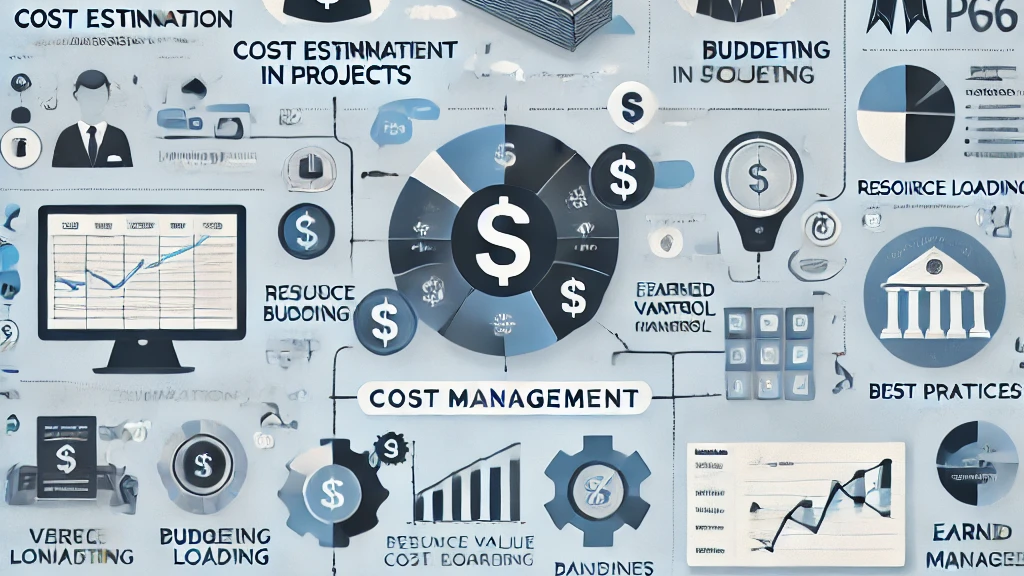
Visit cost management includes all the activities involved in planning, estimating, budgeting, financing, monitoring and controlling costs in order to deliver a project within the approved budget.
It covers the entire project life cycle and is based on four key processes:
- Cost estimates costing of resources, activities and work packages
- Budgeting consolidation of estimates to establish a baseline
- Cost control monitoring actual expenditure, analysing variances and forecasts
- Earned Value Management (EVM) integration of scope, planning and costs
Cost/schedule integration: the real lever
Costs and planning are inseparable:
- Activities consume resources → therefore costs
- Delays prolong resource utilization → increase costs
- Changes in scope or productivity impact both deadlines and budgets
This is why time/cost integration is essential.
Tools such as Primavera P6, link resources and costs to activities, providing a real-time view of physical and financial progress.
How Primavera P6 supports cost management
1. Resource & Cost Loading
Each activity can include :
- Resources (labor, equipment, materials)
- Cost accounts
- Unit and total costs
➡️ Enables phased financial planning over time
2. Cost baselines
P6 can be used to freeze cost/planning references to compare forecast vs. actual
3. Earned Value Analysis
P6 automatically calculates :
- PV (Planned Value)
- EV (Earned Value)
- AC (Actual Cost)
- CPI / SPI
➡️ Foresees :
- EAC (Estimate at Completion)
- ETC (Estimate to Complete)
4. Activity profiles & S-curves
Visualization of costs over time → rapid identification of deviations
A simple example of Earned Value
Expected sales: €100,000 over 10 weeks
À Week 5 :
- PV = €50,000
- AC = €60,000
- EV = €40,000
Analysis:
- Delay (EV < PV)
- Cost overrun (EV < AC)
Calculations :
- CPI = 0.67 → cost inefficiency
- SPI = 0.8 → schedule delay
➡️ P6 automates these calculations in a cost-intensive schedule
✅ Best practices
- Structuring a CBS aligned with the WBS
- Maintain reliable resource libraries
- Synchronize cost and schedule updates
- Regular monitoring of actual costs (ERP / field)
- Continuous schedule (EAC / ETC)
❌ Frequent errors
- Working in silos (costs vs. planning)
- Using obsolete rates
- Do not burden activities with resources/costs
- Planned vs Actual without KPIs
- Ignore the impact of changes on baselines
Conclusion
Cost management is no longer an isolated financial function - it's a pillar of the project controls.
The ability to :
- link each euro to an activity,
- each resource to a period,
- each deviation to corrective action,
makes the difference between a project that's been imposed and one that's under control.
Thanks to tools like Primavera P6, and an integrated time/cost approach, project teams are moving from reactive to proactive management. proactive and predictive.
How do you manage costs in your planning? Resource loading, cost accounts, EVM? Let's talk - this is where project controls become strategic.
 Français
  English