Effective Float (Slack) Management in Project Planning: Definition, Legal Aspects, Technical Application, and Tools
1. Introduction :
In project management, particularly in complex construction and engineering projects, effectively understanding and managing the float (also called float) is essential for ensuring deadlines are met. Float represents the amount of time an activity can be delayed without impacting the overall project completion date.
Mismanagement or misunderstanding of float can lead to costly disputes, delays, and inefficiencies. This article explores the concept of float, its legal interpretations, technical applications, analytical tools, and best management practices.
2. Definition of float (margin)
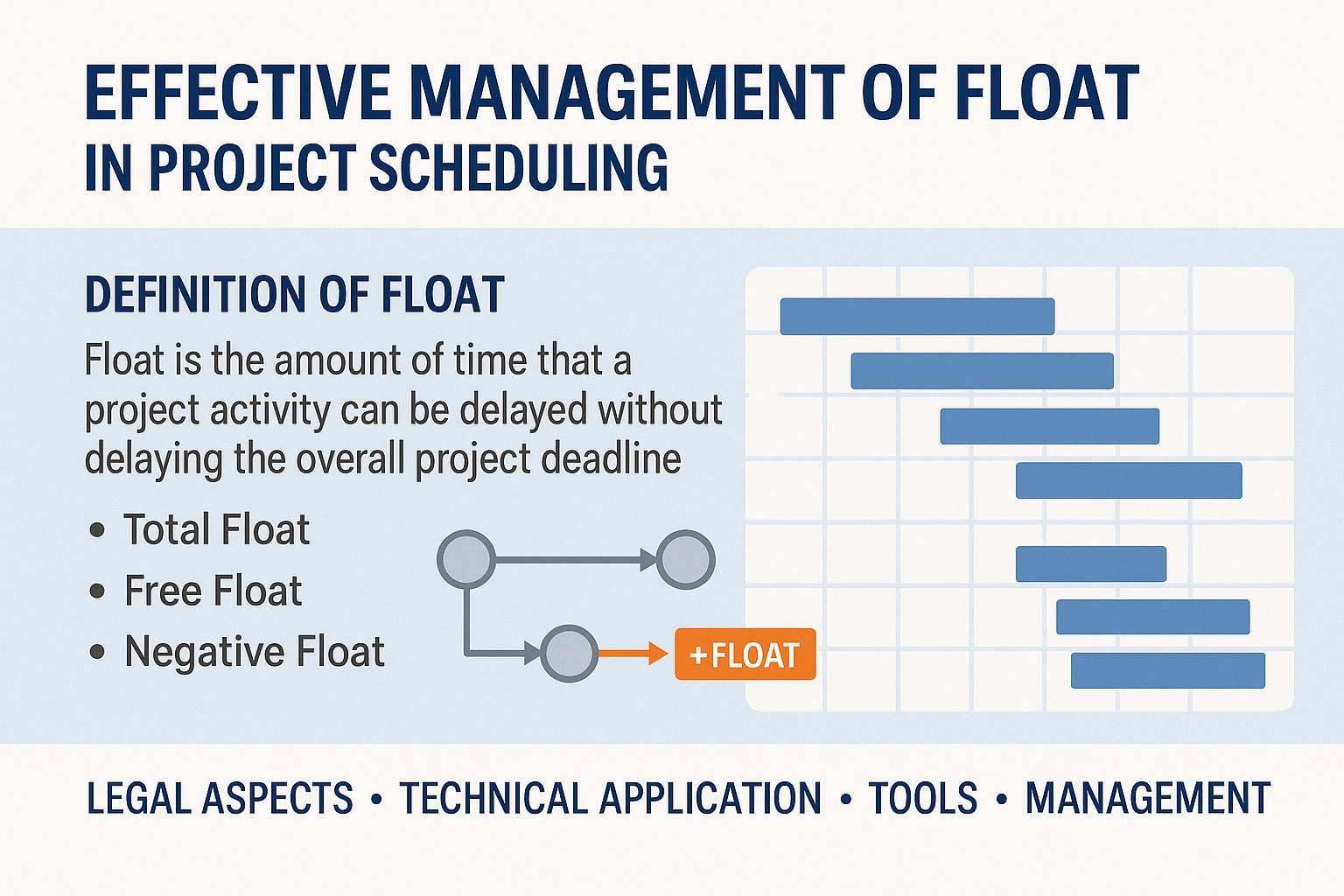
The float corresponds to the time an activity can be delayed without causing a delay
- of the global project end dateTotal Float) or
- from the start of a dependent activity (Free Float).
There are several types of floats:
- Total Float Float
- Free Float The amount of time an activity can be delayed without delaying the earliest start of a successor activity.
- Negative Float The project is behind schedule.
The float is determined during the analysis of the Critical Path Method (CPM). Critical path activities have zero total float, meaning any delay to these activities will directly delay the project.
3. Legal and Contractual Considerations
The float is often a subject of dispute between contractors and clients. Its legal treatment varies, but three main approaches exist:
- The float belongs to the project Shared resource between the contractor and the client
- First come, first served The part that uses the float first benefits from it, which can generate conflicts
- Float property clauses : Some contracts explicitly define who owns it, sometimes at the expense of flexibility
Contractual clauses related to float must be clearly defined to avoid ambiguity. In case of dispute, courts examine:
- if the float was used reasonably
- Who controlled the schedule
- if its use helped to limit or, on the contrary, to worsen the delays
4. Application of float in planning
Technically, the float is calculated using scheduling methods like the Critical Path Method (CPM). Key parameters include:
- Early Start (ES) - earliest start
- Late Start (LS) – latest start
- Early Finish (EF) – earliest finish
- Late Finish (LF) – latest finish
The calculation of the float is as follows:
Total Float = LS − ES = LF − EF
An accurate estimation of the float allows for:
- Identify critical and non-critical activities
- Reallocate resources to the critical path
- Prioritize follow-up and control efforts
5. Float Management Tools
Several software tools allow for the calculation and management of float:
- Primavera P6, : industry standard for large projects, with advanced float analyses
- Microsoft Project widely used for medium-sized projects
- Asta Powerproject : widely used in construction for float visibility
- Open Plan / Spider Project Advanced features for complex modeling and risk analysis
These tools offer visualizations (Gantt charts, logic networks) that facilitate understanding of float distribution and project risks.
6. Best Practices for Managing Float
Effective float management relies on the following practices:
- Early identification : analyze the float from the development of the reference schedule
- Regular follow-up update the schedule to track the float's progress
- Transparent communication share information with stakeholders
- Contingency planning Use the float as a buffer against risks
- Preservation strategy Avoid consuming the float unnecessarily and track its usage
- Contractual clarity : Explicitly define the use and ownership of the float
7. Conclusion
The float is not simply a planning artifact: it is a strategic resource in project management.
By mastering its definition, legal implications, and technical aspects—and by relying on appropriate tools and rigorous practices—project managers can reduce risks, avoid disputes, and improve overall project performance.
A clear float management policy and a proactive approach can make all the difference between a controlled project and one that is runaway or subject to litigation.
 Français
  English
  Español
  العربية