Strategic PMO: from a support function to a lever for value creation
Introduction:
In today's complex environment, organizations must simultaneously multiple projects, programs and portfolios, often in a context of changing priorities, strong constraints and high stakeholder expectations.
In this context, a Well-structured and properly deployed PMO is no longer limited to a simple support function: it becomes a key strategic partner, guaranteeing project alignment with corporate strategy, operational efficiency and value creation.
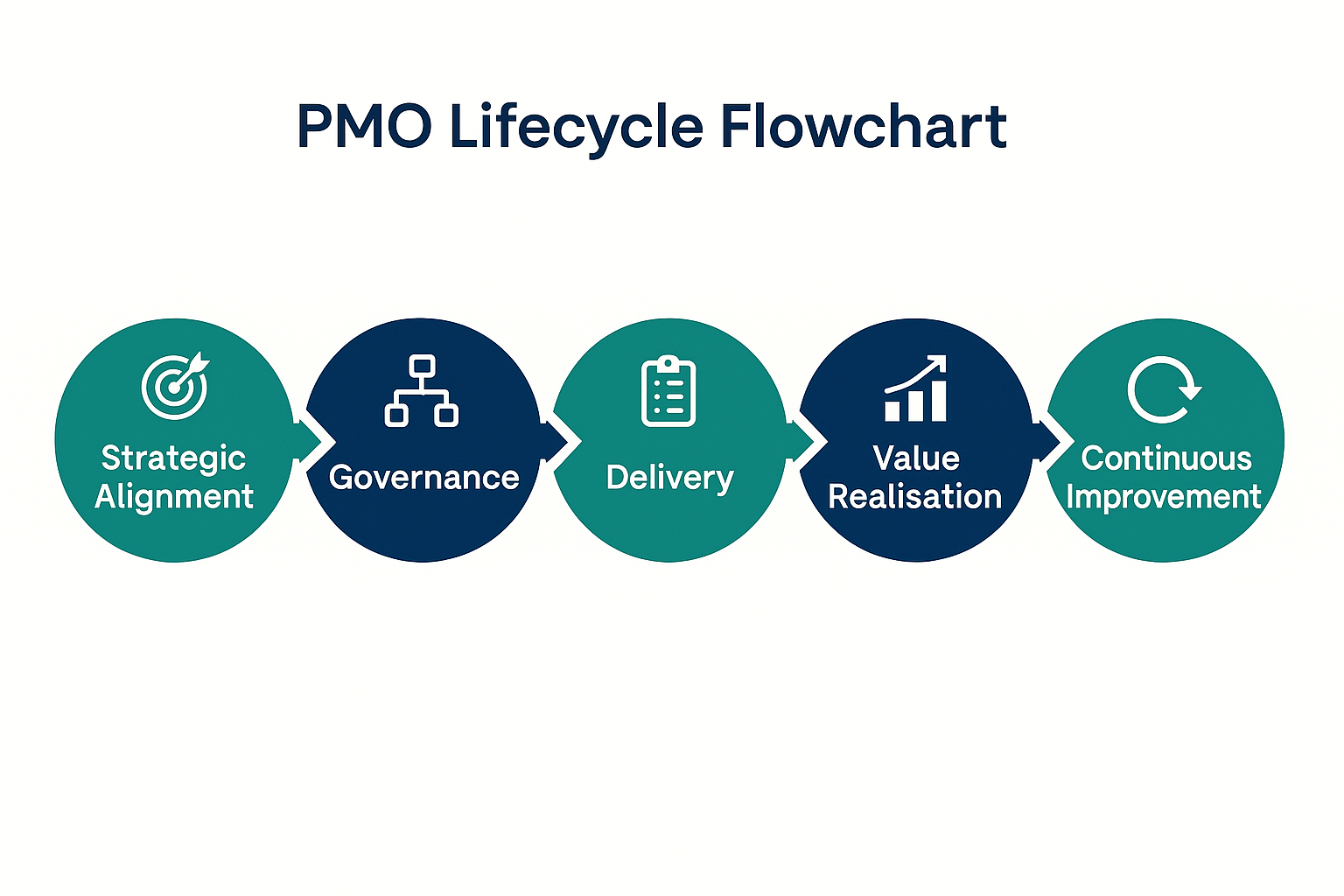
What is a PMO? Definitions and levels
A Project Management Office (PMO) is an organizational entity responsible for define, maintain and guarantee the application of project management standards and practices. Its scope may vary: it may be limited to a support role, or may even take on responsibilities of its own. control or direct management of projects.
PMO types
The literature generally distinguishes three main types of PMO:
Supportive PMO
Provides models, best practices, mentoring and methodological assistance, with a relatively low level of control.
Controlling PMO
Demand the compliance with standards, methodologies and governance rules of the organization.
Directive PMO
Manage projects directly, allocates resources and has a strong decision-making authority.
These categories are not set in stone: PMOs often evolve over time in response to new developments. organizational maturity level, and can combine several features.
Key functions and responsibilities of a PMO
According to best practices and recent empirical research, an effective PMO must perform several essential functions:
Project governance and standardization of methodologies
Operational support for project teams
Performance monitoring (deadlines, costs, scope, risks)
Multi-project resource and priority management
Reporting and transparency to management
Monitoring value creation and project benefits
PMO organization: structure and governance
The way a PMO is structured strongly influences its effectiveness.
1. Positioning and authority
Line of authority
The PMO must generally be attached to the general management or C-level, to provide visibility and legitimacy.
Decision-making authority
Powers of governance, resource allocation and standards enforcement must be clearly defined. Without this, the PMO runs the risk of being bypassed or ignored.
2. Scope and catalog of services
The PMO must clarify :
visit services it provides (methodology, reporting, governance, coaching...)
which remains the responsibility of project teams
Some services may be :
mandatory (e.g. risk reporting)
optional (e.g. methodological coaching)
3. Roles and resources
An effective PMO must be composed of profiles combining project management expertise and organizational influencing skills.
Examples of roles:
Methodology Manager
Governance Manager
Tools and processes specialist
Resource Manager
Profit follow-up manager
The PMO must have sufficient resources and appropriate tools, to avoid being reduced to a purely administrative function.
4. Maturity and evolution
In many organizations, the PMO is gradually evolving:
Support → methodological assistance
Control → governance and standardization
Directive → direct project management
Les maturity models are used to assess the current state and define a roadmap for improvement.
5. Governance and supervision
It is recommended to install :
a steering committee or governance board composed of senior sponsors
from escalation and decision-making processes for resource conflicts or project drifts
6. Indicators and continuous improvement
An effective PMO must define relevant indicators, for example:
Quantities
meeting deadlines
respect for budgets
perimeter control
Qualitative
stakeholder satisfaction
quality of deliverables
capitalizing on feedback
These indicators must be regularly reviewed to improve practices.
Best practices to achieve results
Strong executive sponsorship
Without clear management support, For example, a PMO has difficulty imposing governance or obtaining the necessary resources.
Alignment with strategy
PMO objectives must be directly linked to organization's strategic objectives.
Examples:
oriented strategy speed to market → measure delays and resource bottlenecks
oriented strategy innovation → include experimentation and risk-taking indicators
Data use and transparency
Les dashboards, PMIS tools and automated reporting allow :
real-time visibility
early detection of problems
faster decision-making
Balancing control and flexibility
A PMO that's too rigid can provoke resistance; too flexible, chaos.
The best approach is often hybrid :
strict governance for critical projects
more flexibility for low-risk projects
Focus on value creation
The PMO must not only control deliverables, but also ensure that projects produce real business results :
return on investment
customer satisfaction
cost savings
regulatory compliance
The monitoring profit realization is therefore essential.
Continuous learning
Key practices include :
post-project reviews
lessons learned sessions
sharing best practices
adapting to new technologies and regulatory constraints
Communication and stakeholder engagement
Regular and transparent communication is essential:
project status
risks and changes
strategic decisions
The PMO must be perceived as a partner, and not simply as a control body.
Adapted tools and technologies
Project and portfolio management software, analytical dashboards and collaborative tools are important.
However, processes, skills and organizational culture remain the determining factors.
Challenges and pitfalls to avoid
Even with the best intentions, many PMOs fail to reach their potential.
Common causes include:
lack of executive support
vague mandate
excessive bureaucracy
lack of skills or resources
lack of indicators to measure real value
Organizational implementation: a deployment framework
1. Diagnosis phase
analyze current project management practices
identify problems (delays, overruns, misaligned priorities)
understand management's strategic objectives
gather stakeholder expectations
2. Design phase
define PMO's mission, vision and mandate
determine the right type of PMO
define the governance structure
establish a catalog of services
design processes, models and tools
3. Implementation phase
set up the PMO team
deploy methodologies and tools
train project teams
start with pilot projects
4. Monitoring and continuous improvement
define KPIs aligned with value
carry out regular reviews
integrate feedback
5. Sustainability and growth
integrate the PMO into the organizational culture
maintain strategic alignment
Gradually expand the PMO's scope as maturity increases
Lessons from recent research
Empirical studies show that PMOs contribute strongly to strategic success when they fulfill several key roles:
participation in strategic management
development of methodologies and skills
performance monitoring and control
improvement organizational communication
contribution to sustainability of the value created
PMOs evolving into strategic partners providing decision-making information at executive level generally outperform those who limit themselves to project administration.
Measuring PMO success: indicators and KPIs
Strategic alignment
% projects aligned with strategic objectives
% of investments allocated to priority projects
Delivery performance
rate of projects delivered on time
respect for budgets
perimeter compliance
Profit realization
actual vs. expected profits
stakeholder satisfaction
ROI and total cost of ownership
Resource efficiency
resource utilization rate
number of over-allocated resources
optimization of shared resources
Quality and risk
number and severity of incidents
changes in scope of consolidation
project quality indicators
Capacity and maturity
project manager training
PMO maturity level
methodology adoption rate
Stakeholder indicators
sponsor and team satisfaction
PMO's perceived value
confidence in data and processes
PMO operational performance
PMO operating costs
report production time
efficiency of tools and processes
Conclusion
A Well-designed and well-positioned PMO is much more than a governance mechanism or an administrative layer.
When it is aligned with strategy, with clear authority, staffed by competent professionals and focused on value creation, It can transform an organization's performance.
Results include :
a higher project success rate
a better use of resources
a clearer decision-making
a increased stakeholder confidence
Ultimately, the PMO becomes a strategic leverage to transform projects into measurable value for the organization.
 Français
  English