Contractual deadline obligations: why the schedule is a legal document
1. Introduction
In the world of energy and infrastructure megaprojects, time isn't just a project management variable - it's also a key factor in the success of a project. a contractual obligation. Delays may result in Liquidated Damages (LDs), disputes, and even termination of contract.
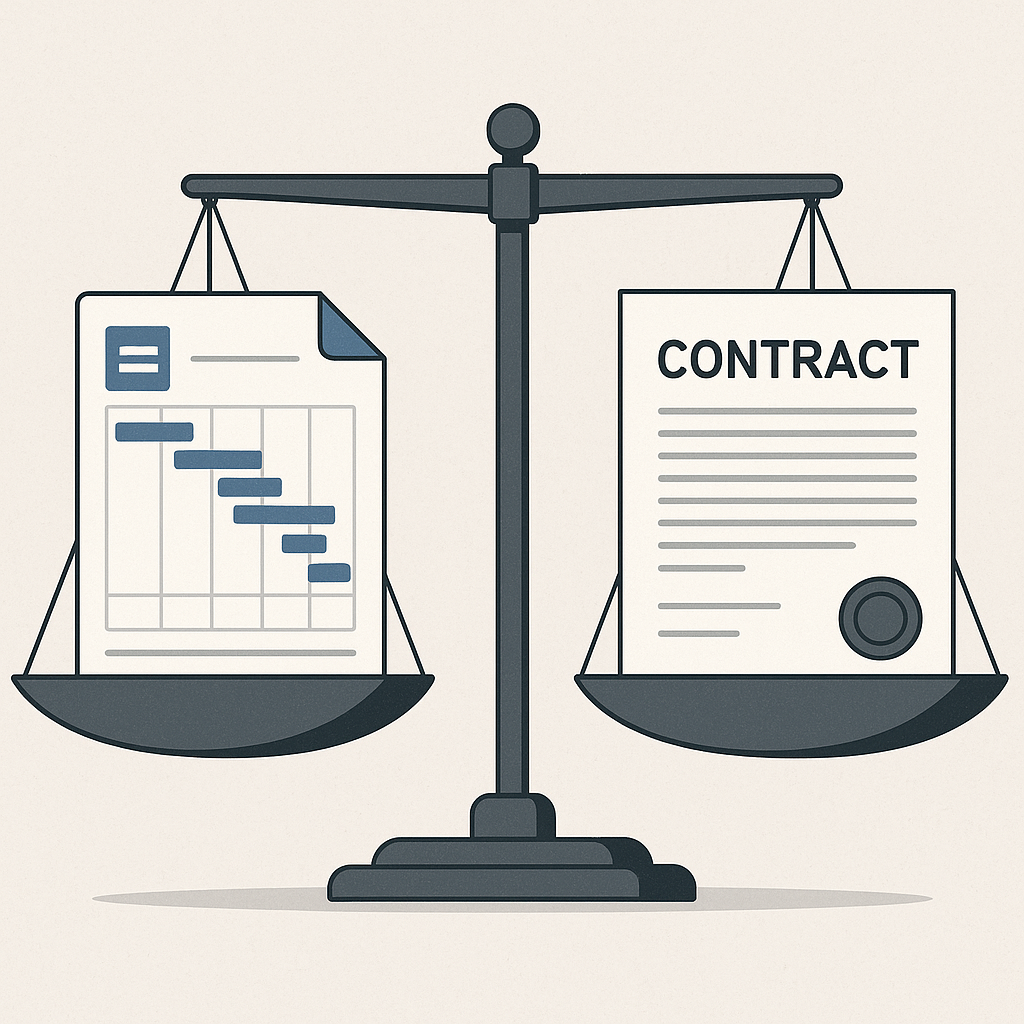
However, many project stakeholders still consider schedules as mere in-house tools for planners, rather than as engaging instruments with a real impact. real legal scope. Within contractual frameworks such as FIDIC (Clause 8.3), contracts NEC or the EPC, the program (planning) is in practice a contractual document.
This article explains why project schedules are legally binding, and how organizations can apply sound planning and scheduling for protect themselves against litigation and maximize the success of their projects.
2. Deadline obligations in FIDIC, NEC and EPC contracts
FIDIC Clause 8.3 - The program
Within the framework of FIDIC (Conditions of Contract for Construction), the Clause 8.3 requires contractors to provide a detailed work schedule. This program must include :
Presenting logical links between activities
Highlighting the Critical Path
Be regularly updated to reflect actual progress
Be submitted to the Engineer for approval
Failure to comply with these requirements may result in rejecting claims, disputes or withholding payments.
NEC contracts - Early Warnings and accepted programs
Contracts NEC are based on the principles of collaboration and transparency. The contractor must submit a Accepted Programme, which becomes the reference for :
Measuring project progress
Evaluating compensation events
Determining eligibility for deadline extensions
In the NEC model, the schedule becomes a central element of contract administration, and not simply a project execution tool.
EPC contracts - Time is money
In contracts EPC (Engineering, Procurement, Construction), the contractor carries the overall responsibility for time, cost and performance. The reference schedule then forms the basis for :
Trigger milestone payments
Apply late payment penalties (LDs)
Manage interfaces between numerous subcontractors
In practice, poorly structured or badly managed planning can expose the entrepreneur to financial penalties of several million euros.
3. Why schedules are legal documents
A schedule is not simply a Gantt chart. When integrated into a contractual framework, it becomes :
Proof of intent
It shows how the contractor planned to meet the contractual deadlines.
Proof of performance
It reflects actual progress in relation to contractual obligations.
Proof in litigation
Courts and arbitration tribunals often use the last program approved as a reference for analyzing delays.
In disputes relating to delays or requests for extension of time (EOT), the quality of the planning can determine the outcome of the dispute.
4. Best practices for contractually robust planning
Planning and scheduling
Developing schedules based on a clear network logic (avoid excessive stress)
Align the WBS with contractual deliverables
Performing DCMA 14-Point Check quality controls
Updates and revisions
Update progress regularly (monthly or according to contractual requirements)
Maintaining contemporary documents (daily reports, progress logs)
Transparent justification of changes (scope variation, delay, acceleration)
Integrating risk
Use the’Schedule Risk Analysis (SRA) to quantify temporal uncertainty
Add float and strategic buffers to protect critical milestones
Documenting early warning notices (especially in NEC contracts)
Litigation preparedness
Keeping archives for forensic analysis (XER files, as-built schedules)
Document separately delays attributable to the customer and those attributable to the contractor
Maintain a clear distinction between baseline and updates to avoid moving target disputes«
5. The consequences of poor planning
When schedules are not treated as contractual instruments, organizations expose themselves to :
Claims rejection for lack of documented proof
Late payment penalties (LDs) for late delivery
Cash flow disruption if milestone payments are blocked
Weakened bargaining power in litigation
6. Conclusion
In today's environment of major projects, schedules are no longer just management tools - they are legal documents.
By aligning planning practices with contractual requirements (FIDIC, NEC, EPC) and applying rigorous project control methods (quality controls, regular updates, risk integration), organizations can :
Protecting yourself against litigation
Obtaining legitimate time extensions
Building trust with customers and partners
Deliver projects with predictability and control
At ALVID Consulting, we support our customers in the creation of contractually robust schedules, at the interface between project management and construction contract law.
 Français
  English